
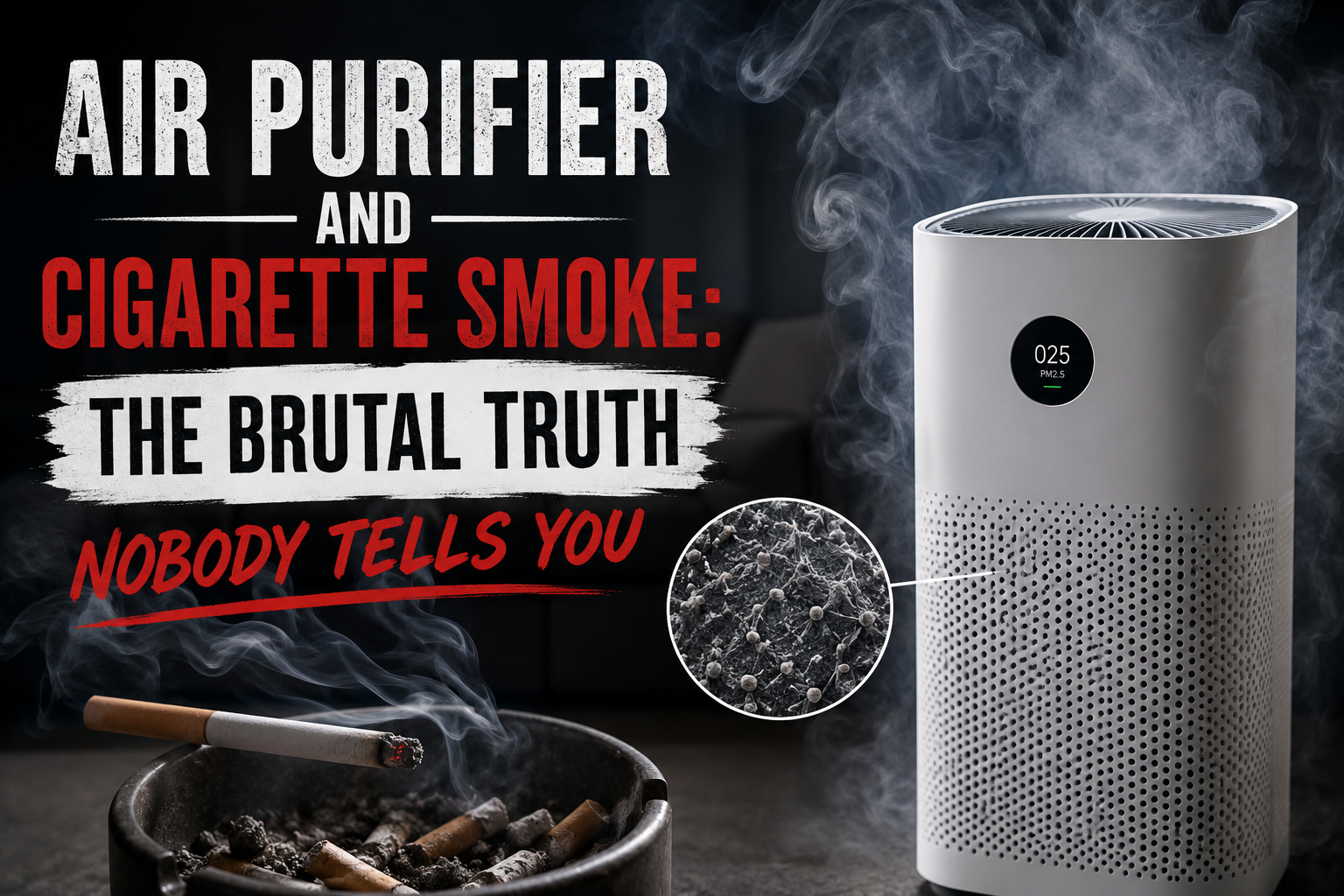
So you start googling. Can an air purifier handle cigarette smoke, or is the whole industry selling you a fairy tale? I’ve tested more units than I’d like to admit, lived with smokers, been the smoker, and I’m going to tell you exactly how this works in the real world. No fluff, no manufacturer talking points.
What Cigarette Smoke Actually Is (And Why Most Purifiers Fail)
Here’s the thing nobody explains properly. Cigarette smoke is not one thing. It’s two completely different problems wrapped into one disgusting cloud.
The first part is particulate matter. Tiny bits of ash, tar, and burned plant material floating around. Some of these particles are so small they go straight into your lungs and stay there. A decent HEPA filter catches this stuff without breaking a sweat.
The second part is the bastard that ruins everything. Gases and volatile organic compounds. VOCs, formaldehyde, ammonia, hydrogen cyanide, and a few hundred other charming chemicals. These are gases, not particles. A HEPA filter does absolutely nothing to them. Zero. They pass right through like the filter isn’t even there.
This is why your buddy bought a $200 “HEPA air purifier” and his apartment still smells like an ashtray. He got half the equation. The half that doesn’t include the smell.
Can an Air Purifier Really Remove Cigarette Smoke?
Yes, but only if it’s built for the job. Most aren’t. The air purifier and cigarette smoke combination only works when the unit has both serious HEPA filtration and a thick activated carbon filter. Not a sprinkle of carbon dust on a mesh, an actual heavy carbon bed measured in pounds.
I’m talking 5 pounds of carbon minimum for a smoker’s room. Some serious units pack 15 pounds or more. That’s the difference between masking the smell for an hour and actually pulling it out of the air.
If the spec sheet doesn’t tell you the carbon weight, that’s your red flag. Cheap brands hide that number because they know it’s embarrassing.
What a Good Setup Will Do
- Visibly clear smoke from the air within minutes if the unit is sized right for the room
- Strip out the floating particulates that coat your furniture and lungs
- Capture the VOCs and gases that cause that lingering stale smoke stench
- Reduce secondhand smoke exposure for anyone else in the house
- Keep your walls, ceilings, and electronics from going yellow over time
What Even the Best Purifier Won’t Do
- Remove smoke that’s already soaked into fabric, drywall, or carpet
- Make smoking indoors completely “safe” (it isn’t, sorry)
- Work if you run it on the lowest setting in the corner of a huge room
- Last forever without filter changes (more on this nightmare in a minute)
- Fix the problem if your HVAC system is also pumping smoke around the house
The Three Filter Types That Actually Matter
Forget the marketing buzzwords. Ionizers, UV lights, plasma whatever, most of it is theater. For smoke, three things matter, and only three.
1. True HEPA Filter
This is your particulate killer. A real HEPA filter catches 99.97% of particles down to 0.3 microns. Cigarette smoke particles range from about 0.1 to 1 micron, so a good HEPA grabs most of them. Note I said true HEPA, not “HEPA-type” or “HEPA-style.” Those weasel words mean it didn’t pass the test.
2. Activated Carbon Filter
This is the smell killer. Carbon works by adsorption, basically the gas molecules stick to the carbon’s surface like flies to flypaper. The more carbon you have, the more crap it can hold before it’s saturated. A thin carbon pre-filter is useless for a heavy smoker. You need a fat carbon bed, period.
3. Pre-Filter
This is the unsung hero. A washable pre-filter catches the big stuff, lint, hair, ash flakes, before they clog up your expensive HEPA and carbon. Skip this and your real filters die three times faster. Vacuum it weekly if you smoke daily.
How to Size an Air Purifier for a Smoking Room
This is where almost everyone screws up. They buy a purifier rated for their room size and wonder why it barely makes a dent. The room size rating on the box is for normal household dust, not for cigarette smoke.
For smoke, you want a unit rated for at least double the actual square footage of your room. If your living room is 300 square feet, get a unit rated for 600 square feet or more. You want enough air changes per hour to actually keep up with active smoking.
Look at the CADR rating, specifically the smoke CADR number. Higher is better. A smoke CADR of 200 or above is where things start to feel effective in a typical room. Below 150 and you’re basically running a fan with a filter strapped to it.
Where to Put the Damn Thing
Placement matters more than people think. I’ve seen guys drop a $500 purifier in a corner behind a couch and wonder why it doesn’t work. The unit needs air flowing into it freely.
- Put it close to where the smoking happens, not across the room. If you smoke at your desk, the purifier sits on or near the desk
- Keep it at least 6 inches away from walls and furniture so airflow isn’t choked
- Higher up is better since warm smoke rises. A unit on a shelf often outperforms one on the floor
- Don’t bury it under a blanket, a stack of magazines, or your laundry pile (yes, people do this)
- Run it 24/7 on at least medium speed. Turning it on only when you light up is too late
The Filter Replacement Reality Check
Here’s the part the salesman doesn’t mention. Filters die fast in a smoker’s home. The carbon saturates, the HEPA clogs with tar, and once they’re done, they’re done. Cleaning them doesn’t bring them back.
Expect to replace HEPA filters every 6 to 12 months in a smoking environment, and carbon filters every 3 to 6 months. Non-smoking homes get years out of the same filters. You don’t. The tar in cigarette smoke is brutal on filter media and there’s no shortcut around it.
Factor this cost in before you buy. Some brands sell cheap units and then bend you over on filter prices. A $150 purifier with $90 filters every four months is not actually cheap. Run the math on annual filter cost before you click buy.
Five Brutally Honest Tips for Smokers Using Air Purifiers
1. One Unit Per Room, Always
Stop trying to clean the whole house with one machine. Smoke doesn’t travel politely through doorways. Get a dedicated unit for every room where smoking happens, and put smaller units in adjacent rooms where the smell drifts.
2. Crack a Window When You Can
No purifier on Earth beats actual fresh air exchange. If the weather lets you, open a window during and after smoking. The purifier handles what’s left behind. Together they work twice as well.
3. Smoke in the Same Spot Every Time
It sounds gross but it’s smart. If you confine smoking to one chair, one room, one corner, you can concentrate your cleaning power there. Spreading the habit across the whole house spreads the damage too.
4. Wash Soft Surfaces Regularly
The purifier cleans the air. It does not clean your couch, your curtains, or your bedsheets. Those soak up smoke like a sponge and then slowly release it back into the air for weeks. Wash everything washable on a regular schedule or the purifier is fighting a losing war.
5. Don’t Cheap Out on the First Buy
I know it’s tempting to grab a $79 unit on Amazon. But for cigarette smoke specifically, cheap units are a waste of money. You’ll buy three of them in two years and still hate the smell. Spend once on something serious and be done with it.
What About Weed Smoke and Cigars?
Same rules, slightly different problem. Weed smoke has heavier particulates and a stickier residue. Cigars are even worse, denser smoke, more tar, far stronger smell. Both need the exact same setup, HEPA plus heavy carbon, but you’ll burn through filters even faster.
If you’re a daily cigar guy, plan on replacing carbon every two to three months and don’t pretend otherwise. Cigar smoke is the boss fight of indoor air quality.
Common Myths That Need to Die
- “Ionizers neutralize smoke.” They produce ozone, which is a lung irritant and doesn’t remove the smell, it just oxidizes some molecules and leaves new ones behind. Skip them
- “UV light kills smoke.” UV is for microbes, not chemical gases. It does nothing measurable for cigarette smoke
- “Scented sprays handle it.” They mask the smell for ten minutes and then you smell stale smoke plus cheap perfume. Worse than the original problem
- “Bigger purifier always wins.” Not if the carbon is thin. A smaller unit with serious carbon beats a giant one with a token carbon layer
- “Once the air looks clear, you’re done.” The gases you can’t see are the ones causing the smell and the health damage. Keep the unit running
The Bottom Line on Air Purifier and Cigarette Smoke
Yes, an air purifier can handle cigarette smoke. But only if you buy the right kind, size it correctly, place it smart, and stay on top of filter changes. The right setup genuinely changes how your home feels. The wrong one is an expensive paperweight.
If you smoke and you’re tired of your place smelling like a 1987 bowling alley, this is one of the best quality of life upgrades you can make. Your guests will notice. Your partner will notice. Your lungs will probably notice too, even if you don’t quit.
Get serious about it once, do it right, and stop pretending a $40 gadget with a glowing blue light is going to fix anything. You deserve to breathe clean air in your own home, even with a cigarette in your hand. Now go buy something that actually works.